For many of us, the ultimate Sunday Dinner had to always be roast beef and Yorkshire pudding. Not that it happened every week, but when it did, it always meant a really satisfying meal. My Mother in law’s birthday is this week, so we decided to have the family over for Sunday Dinner. What else to make for the older generation but roast beef, and if you want to really see a group of septuagenarians get excited, roast a prime rib! A birthday cake was also in order, so I settled on making a chocolate cake of some sort, and figured I’d give it some thought.
We toddled off to market, picked up a few carrots and parsnips (my wife’s favourite easy vegetable, mashed together), settled on mashed potatoes (what else?) , and picked up a hefty 13 pound rib of beef at the butcher. Back to the house, and a serious cake project was underway. I had prepared the layers the night before, so that they would be easy to handle, and cut them crosswise into two. I whipped up some cream with cocoa and icing sugar, and layered it in between, placing the cake back into the fridge to cool. (It’s important to note, that for a nice even top, invert the layers so that the piece on top is the base of one of the layers, with nice flat surface to work on.)
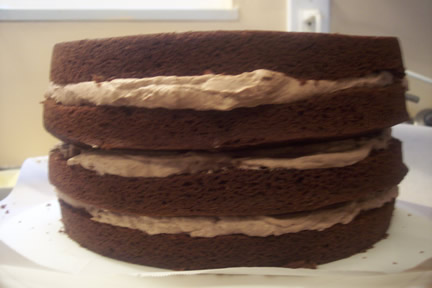
Preparing a cake to be glazed with ganache involves some serious engineering and sculpture, so I prepared the ganache with 70% dark chocolate (being very careful not to stir it too much for fear of making it volatile and seizing it) and an equal amount of cream, setting it aside once melted and mixed well. I removed a third for my base coats, so that I could spread it on without getting crumb into the rest of it. A trim of the filled layers to provide straight, even edges, and I took a small palette knife, and spread a thin layer of chocolate all over the cake, to create a seal. Back into the fridge to set.
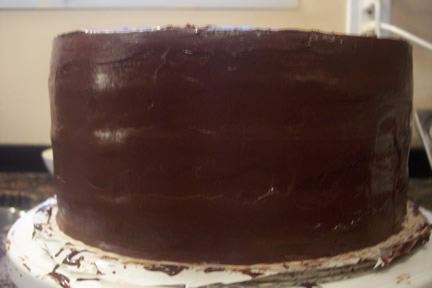
Once firm, another thin coat, this time trying to even out any irregularities in the sides. Fridge again.
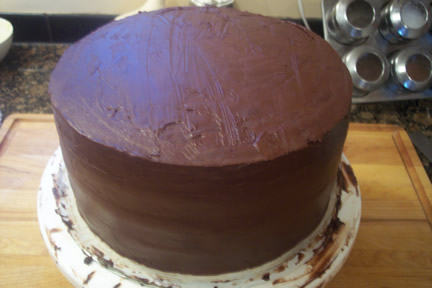
Half an hour later, another thin coat, and this time it’s looking quite nicely shaped, and should provide a nice smooth base for coating. After being cooled and the remaining ganache heated up again over hot water, I was ready to glaze. I carefully transferred the cake to a wire rack over a pan lined with parchment, to allow the excess to drip off the edge rather than pool at the base. The remaining ganache was poured over and with a minimal amount of coaxing from my spatula, allowed to gently flow over the top and down the sides.
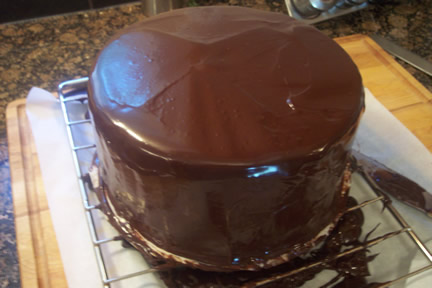
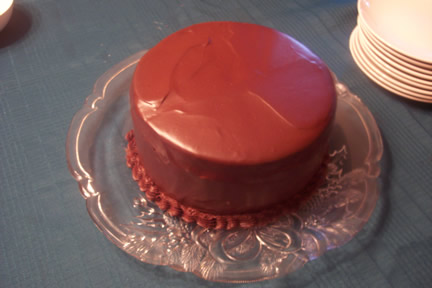
This is where the preparation comes in to play. The chilled structure underneath allows the ganache to cool and coat evenly as it flows, creating a picture perfect top coat that will remain shiny and smooth once set.I lifted the rack off of the tray, put it onto another, and set it in the fridge. The excess ganache was scooped up and placed in a piping bag with a small star tip to decorate the edges once the cake was moved onto its platter, and set aside to cool until the consistency of soft butter.
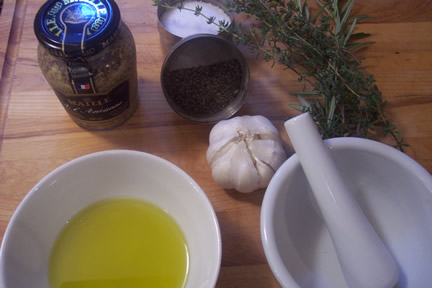
The cake under control, it was by now mid afternoon and time to think about the main course. I grabbed the required elements for a nice rub: a head of garlic, grainy Dijon, coarse salt, olive oil, pepper, and herbs from the garden. Out came the mortar and pestle, and into it placed the peeled garlic and a generous pinch of salt. I mashed it up a bit to break down the garlic into a coarse pulp, added a twist of pepper and the chopped herbs (thyme and rosemary), and a knob of grainy mustard the size of an egg. Again with the mortar and pestle, baptizing it with a generous dose of olive oil, until a reasonably fine paste had been achieved.
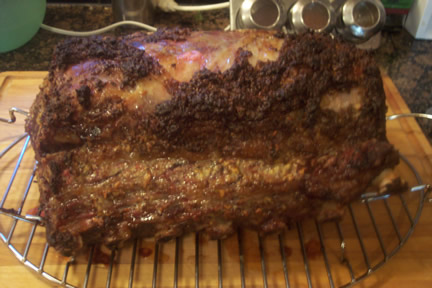
The rib was rubbed, place on a rack in a roasting pan and the oven prepared: 375 in the convection, (400 without) just for an hour to get nice colour, at which time the temp would be dropped by 50 degrees to allow a nice gentle roast for the remaining hour or so. I fixed the batter for the Yorkshires: the tried and true hotel banquet recipe; equal parts by weight flour, egg, milk. 250 grams of each yields a dozen, so I made enough for 24. (In volume measure it works out to 1 2/3 cups flour, 1 cup milk, and 4 eggs per, plus a nice pinch of salt)
That taken care of, I peeled the vegetables and potatoes, placed them in pots ready to go and did a bit of prep for the gravy. Whenever I cook a large roast or bird, I set a small pot aside for the carrot (and in this case parsnip) peelings, onion and garlic trim, bits of herb stems and celery tops, etc, and have that simmering on the back of the stove. If there are the odd bits of trim, even better, as the resulting quick stock provides a nice amount of flavour for making the gravy from the drippings. I tend to dice up a half an onion, a couple of stalks celery, and the ends of the carrots, parsnips, etc and transfer those to either around the roast without crowding it causing it to stem, or into an oven proof saute pan for a nice roast. Once the roast comes out of the oven, the rack is lifted, the vegetable if not already in there are added to the drippings and the whole mess is placed on a medium high burner (still in the roasting pan, of course) and caramelized gently. Enough flour is added to make a roux, usually 1/3-1/2 cup per litre of stock, and once a golden brown, the liquid can be added. I always start with a deglaze with wine, there’s usually something open by this point for dinner, so a splash into the pan. (the exception to the rule being if you’ve opened an ’82 Mouton for dinner, in which case open something else for the gravy) Strain out the quick stock you’ve made, and add it, bit by bit, stirring constantly until it’s well incorporated. I usually will just let it simmer gently in the roasting pan for a few minutes, to make sure I’ve adequately removed all bits of flavour from the bottom, before transferring it to a sauce pan over low for a simmer until the roast has rested completely. Just before serving, adjust the seasoning and strain.
Oven bumped up to 425, it’s time to get the puddings on the roll. My beaten and weathered muffin tins, who are being saved for this noble purpose, are placed on a baking sheet, the prescribed amount of oil added to each (2 Tbsp or so, about 1/8 inch) and the whole sheet placed in the hot oven fro 10 minutes. Yorkshire puddings rise by the action of the egg-rich batter hitting the hot oil, so this is VERY important. Once hot, a ladle of batter into each tin cup, back in the oven on upper rack, and door closed for 12-20 minutes, until puffed and golden. To prevent them from collapsing, it is important to reduce the oven temperature after 20 minutes (to 300), and prop the door ajar a few inches to allow excess steam to escape and the puddings to dry out. !5 minutes later, ready to go!!
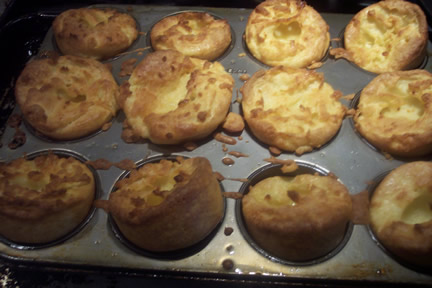
A quick mash of potatoes and veg, roast carved and puddings transferred to a platter, the deafening silence of the family, punctuated by the occasional ping of cutlery vs plate registered success. Two helpings apiece, it took great strength to finish the slice of cake presented, but a valiant effort was made by all. And that’s what it’s all about: TRADITION.