There and back again- from inquisitive cook to “green” chef – part 1

As long as I can remember, I’ve always been interested in food and cooking. We travelled quite a bit as kids, living in Africa when I was very young, back to northern BC, then off to Ontario, back to BC, off to England, then back to BC for good in 1977. I was 8, and settling in West Point Grey was a good place to be a kid. We spent a lot of time in the endowment lands and at Jericho Beach, exploring our surroundings as we always had. We lived in a big house on 13th, and between my older brother and I (who are only a year a part, so had the same circle of acquaintances) there was always a good sized group of boys around the house. One Sunday morning there was a fair group that had spent the night and we were poking around in the kitchen figuring out what to eat. Catholic school had taught us well, as Shrove Tuesday had just passed and the grade 6 class had learned in their discussions of the traditions of Mardi Gras how to make crepes. A crude batter was prepared in the blender, cooked in a couple of cast iron frying pans, and the group was satisfied, not just with the offerings, but the satisfaction of cooking for ourselves.

Every year, we had a family tradition of a pre-school year meeting in which the daily chores would be decided and assigned to my brothers and I. That September, (1979 I guess), I decided that I would like to relinquish my duties as garbageman, and would take on the responsibility of preparing breakfast for the family on a daily basis. Armed with my well worn copy of “the Joy Of Cooking,” I set out to liberate the Green boys of years of porridge for breakfast. Pancakes, omelettes, different egg preparations all became part of the repertoire, and I held my post for the rest of my time at home.

My parents had always been interested in social and environmental issues, so in 1980, following skyrocketing interest rates and house prices, my parents decided that my Dad had had enough of corporate life, and my Mom would work instead, taking a position with the Development agency of the Catholic Church. This meant a fairly substantial income drop, so we moved to South Vancouver, and spent the remainder of my youth living on the East Side.

The 80’s were pretty tumultuous times for those involved in social justice and global awareness, so we became very aware of socio-economic issues, the reality of the global food supply, and the like. In 1985, my parents packed the family up in a 1969 Volkswagen van and drove to Nicaragua, so that they could work with a group of priests who had been working with the Mayan people in Guatemala, and were now in exile in San Juan Del Sur, a beautiful beach town near the Costa Rican border. What a place to be 16! As the revolution was merely 6 years old, the youth were the future and as such were treated like adults. It was common for the high school classes to encompass a demographic of 15-30, and the atmosphere was of excitement and exhilaration. We were there for half the year, during which time we were able to discover exciting new flavours, and really learned an appreciation for ingredients. There was a trade embargo from the US because of the socialist regime, and we learned to cherish the fresh produce and seafood at the market, the fresh pork that was available, and most importantly, we learned like most of the world how to make beans and rice the backbone of the diet. Returning to Vancouver 8 months later, to say we had a new appreciation for the standard of living afforded the average Canadian would be an understatement to say the least.

A couple of years later, as I was finishing High School, I started looking at finding a part time job. A local restaurant near my high school had placed an ad in the morning announcements for part time kitchen help, and I figure since I loved to cook it might be a good thing to try out for a while. I stopped by the Avenue Grill on my way home from school one day, had a brief talk with the Sous Chef, and left my name and number. I got a call from the Chef a few days later and met with her, and started doing prep and making toast on Easter weekend, 1987.

I worked Friday nights and Sunday mornings for the rest of the school year, and learned the basics. The Grill was at that time doing a real California Cuisine thing, all the food was prepared in house, fresh baked muffins and scones, fresh creative salads and sandwiches, and a small dinner menu with pasta and casual but well prepared entrees. Sunday brunch was one of the busiest in town, where it wasn’t uncommon to do 120-150 covers in 4 hours, OUT OF 38 SEATS!! By the time the school year ended, I had been offered full time work for the summer, which I accepted gladly. (At that time I was certain that I was destined to be a rock star, so I just had to make a few bucks to get me through in the meantime).

A few months after I started full time, an apprenticeship became available and was offered, provided I could commit to sticking around for a couple of years to learn the trade. Again, I gladly accepted, and went from prep to sandwiches and salads, to working dinner service within the first year. By the end of my first full year, I was cooking Sunday brunch every week as well as 2 nights on the stove and 2 on the salad station. By the time the second year rolled around, the Sous Chef had left, and it became my responsibility to cook dinner four nights a week and Sunday Brunch. I was happy to accept the challenge, and excited to be able to write specials, learn new techniques, and grow into a larger role. In the fall of 1989, the Chef decided to leave, and at that time, the responsibility to take over the kitchen fell on my shoulders.

The fall of 1989 and spring of 1990 brought great change for me. I had just gotten married the summer before, I had taken on the responsibility of running a small restaurant kitchen, and we had decided to buy our first house. The housing market had gone through the roof, and the only place we could afford was to move to the Fraser Valley. We started looking in Delta and Surrey, and as we looked, prices kept getting higher and higher, pushing us farther and farther east, until we finally bought a small home in Aldergrove, a good hour’s drive from work, in February, 1990. Within a few weeks of the house purchase, Jim, the owner of the restaurant came to me and said he had an idea to do something no one else in town was doing. He really wanted to get into organic food and embracing the natural food movement that had been going on in California. I was sent out to buy a few books and do some research (pre-internet, it meant the library) and picked up a copy of Chez Panisse Cooking, written by then Chef Paul Bertolli. I was fascinated by the story and the concept, and inspired to accept that thought process as the only way to cook. Between my own personal social background and a new move to start a family in the middle of farm country, everything seemed to make sense to go in a real down to earth, “connected with the land” direction. I had a copy of the Canadian Organic Food directory that had been picked up at Kits Natural Foods, and thumbed through it to see who was active in British Columbia. I only knew one organic farmer, Herb Barbolet from Glorious Garnish, and decided to ask him how I could get in touch with other farms, and the BCARA, the local organic farmer’s association. His response was, “You’re in touch. I’m the president. You should come to our meetings in Cloverdale once a month and meet some great people.” I agreed, and in the meantime, he gave me the number of a family in Surrey who had been farming there for a half dozen years.

End part 1. Next: part 2, meeting the Kings
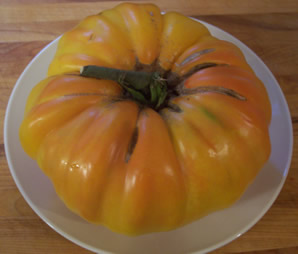
The Striped German

The first of my Sunday Dinner series…

Last night, Milan Djordjevich from Stoney Paradise brought me a gift. Not just any gift to mark my new direction in life, but the tomato to end all tomatoes. Twelve years we have known each other, and there have been many fine specimens to grace my kitchen, but none quite as impressive as this. I opened the paper bag to see what was inside, and there was THE tomato, a 2 1/2 lb Striped German. It sat on the counter for the remainder of service while I contemplated its fate, knowing we were having friends over for dinner tonight, and wanted to see how that one tomato could inspire a meal.

the tomato in question

I woke this morning to see it proudly perched on my kitchen counter at home, and decided that I would hollow it out and use it as a vessel to serve an appetizer, reserving the flesh for something, perhaps the filling. A trip to the market in the morning provided a few complimentary items; peppers, sweet onion, and basil. I had picked up a few chickens in the hope of barbecuing, and figured we had a good start. Once home again, I noticed quite a few windfallen apples on the ground from one of our two trees, and went out to gather them. Not quite perfect, but great for applesauce or something along those lines. The tomato plants provided a few cocktail sized red tomatoes suitable for roasting along with the peppers and onion to add to the filling, and by now, the menu was starting to take shape.

Roasted vegetable relish (served in the Striped German, with fresh baguette)

Roast chicken of some description ( I had given up on the barbecue as it looked pretty gloomy outside)

Something with apples, still under consideration

Half a dozen cocktail tomatoes, halved, one sliced sweet onion, and two peppers, seeded and quartered made their way onto a sheet pan and into the oven with a splash of olive oil and salt. An hour or so at 300 degrees, I figured, and started carving the tomato. The flesh was soft and sweet, so I chopped it lightly, salted it, and placed it in a bowl with a couple of tablespoons of chopped basil.

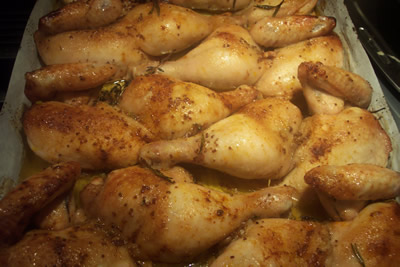
I let it sit while I split the chickens and removed the thigh bones, and put them into a large pyrex pan to marinate. A couple of tablespoons each of honey and grainy mustard whisked together with a tablespoon of balsamic vinegar and a quarter cup olive oil provided a good rub down, topped with a few sprigs from the garden: rosemary, oregano flowers, and thyme, followed by a healthy pinch of coarse salt and about teaspoon of chili powder. Birds comfortably in the fridge, I returned to the tomato flesh, decided to puree it and go from there. The resulting liquid was magic, and it seemed a shame to toss it in with the roasted veg, fresh out of the oven. Maybe just a shooter of cold tomato soup? By the time it was strained, there was only about 10 ounces, not quite enough for the eight of us, so I decided to make some gnocchi, and toss them in the golden elixir.

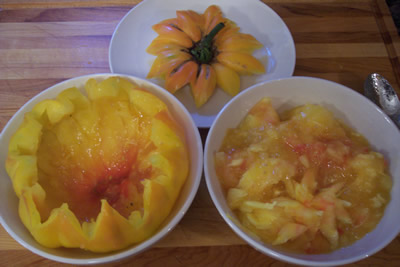
Back to the roasted vegetables, now cooled to room temperature: a brief chop, a splash of balsamic, a healthy dose of chopped basil, a pinch of salt, and into the shell of the German. Potatoes on, things really were shaping up. The windfallen apples were peeled, into a pot with some brown sugar and cinnamon they went, just a splash of water to keep them from sticking, and onto a low simmer. I figured a bit of fun would be nice for dessert, so settled on making some sweet cinnamon waffles, topping them with the applesauce, vanilla ice cream, and caramel. Popped the waffle batter together quickly and put it in the fridge, brought out the birds to be transferred to a sheet pan to go in the convection oven for an hour or so, and took the potatoes off the stove, strained them and allowed them to cool and dry out for a bit.

stuffed and ready to go

By this time, our guests were arriving, so I sliced the bread to go with the tomato relish, and sat down for a drink and a visit. Only the gnocchi to make yet, so we were in good shape. Once cooled to room temperature, I riced and weighed the potato, gather the prescribed amount of flour (1/3 the weight of the potato), a couple of eggs, and put the dough together while I waited for the water to boil. There was still a couple of tablespoons of chopped basil there, so I tossed it in, and rolled, cut, and shaped the gnocchi, laying them out on a sheet pan. By this time, the water was boiling, so in they went in batches (so as not to crowd the pot), and once they floated to the top they were cooled in cold water, strained, tossed in a touch of oil, and set aside.

The chicken was looking pretty good by this point, so I pulled it from the oven to rest, cleaned some yellow beans, and went back to our guests. the tomato shell was all that remained, and it looked quite juicy once all the roasted vegetable relish had been spooned out of it. As I carried the platter back to the kitchen, it seemed a shame not to make good use of the rest of the German, so I diced it up and threw it into the food processor, and strained the resulting liquid to add to the previous batch from the flesh of the fruit.

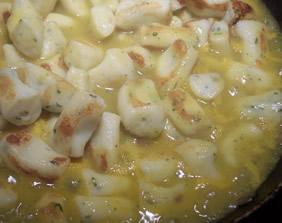
Beans went into the steamer, and two large saute pans were brought out for the gnocchi. Once heated to medium-high, I baptized them with a splash of olive oil, and divided the gnocchi among the two. Just a nice browning, then I tossed in the golden tomato puree and just cooked it enough to heat through. Dinner was served!

Following a respectful break for digestion, it was time to move forward on dessert. The waffle iron was heated, plates were laid out and the waffles cooked and quartered. A generous helping of the not too sweet applesauce on the hot waffle, a scoop of vanilla ice cream on top, and a fair drizzle of caramel sauce over everything put the finishing touches on a great Sunday dinner, the last before school starts and the first in my new-found existence. The kids went back for seconds, thirds even, polishing off the rest of the waffles and applesauce.

What a way to end the summer with good food and good friends, and to think it all started with one tomato, but what a tomato it was! I can’t wait for next week, I’m starting to get hungry again. Actually, there may still be some gnocchi left in the fridge…..

Roasted Vegetable Relish

This vegetable relish is a favourite of ours to serve as the beginning of a summer meal. If I’m cooking on the barbecue, I will grill the vegetables instead of roasting them. I usually slice some fresh baguette, and guests can spoon the relish on as a very informal bruschetta, but it can also be used as a condiment or sauce for grilled chicken or fish. Select ripe cocktail sized tomatoes (no more than a 2 inch diameter) from a thick walled variety such as Cascades.

6 small tomatoes (about 1 lb)
1 sweet onion
2 yellow peppers
2 tbsp olive oil
salt
pepper
2 tbsp basil
1 tbsp balsamic vinegar

Preheat oven to 300 F

Halve tomatoes and arrange cut side up on a baking sheet lined with parchment paper
Peel and slice onion into 1/4 inch thick slices, and arrange on the same baking sheet
Quarter peppers, remove seeds, and arrange on baking sheet as well
Drizzle vegetables with olive oil, sprinkle with salt and freshly ground pepper
Place baking sheet in oven and bake for 45 minutes to an hour, until vegetables are tender and slightly browned. (Turn peppers and onions halfway through baking)
Remove tray from oven and allow to cool to room temperature
Chop all vegetables into a 1/4 inch dice and mix together with basil and balsamic vinegar
Adjust seasoning, if necessary, and serve at room temperature

Split Roasted Chicken With Herbs And Grainy Mustard

A simple split roast chicken is one of our all time family favourite meals. The light marinade adds some interest to the skin and allows it to caramelize nicely.

2 chickens, split, breast and thigh bones removed
2 tbsp grainy mustard
2 tbsp honey
1/4 cup olive oil
1 tbsp balsamic vinegar
1 tsp chili powder
2 sprigs each rosemary, oregano, and thyme
coarse salt

Split chickens in half and remove breast and thigh bones (or ask your butcher really nicely)
Place into a large container (I use a glass 9 by 13 pan, try and keep the chicken in a single layer)
Whisk together mustard, honey, olive oil, and balsamic vinegar and pour over chicken. Massage it in lightly
Sprinkle with chili powder, add herbs, and refrigerate until needed. It’s best if it has about 2 hours to marinate, but because of the vinegar in the marinade, don’t leave it longer than 6 hours.

Preheat oven to 400 F (375 if using convection)

Remove chicken from marinating dish and arrange on a baking pan lined with parchment, spooning remaining marinade and herbs over chicken.
Sprinkle with coarse salt
Place pan in oven and roast chicken until a meat thermometer registers 165 F when inserted into the thickest part of the thigh (it should take about 45 minutes to an hour)
Remove tray from oven and allow chicken to rest for 15 minutes at least before serving.

Basil Gnocchi

Gnocchi are Italian potato dumplings, very easy to prepare, and a great way to use up a few left over baked potatoes. The potatoes are preferably baked, although you can boil them provided you spread the cooked potato out on a baking sheet and allow it to dry out while it cools to room temperature. Wet potato will cause you to have to add more flour, making the gnocchi heavy. Doughs made with potato have a tendency to get soft rather quickly, so it is crucial that once the flour has been added to the dough, that the gnocchi are shaped and cooked immediately. My preferred method for calculating the ratio of flour to potato is to weigh the cooked potato, and divide it by three. That way, you aren’t worrying about cooking exactly 2 pounds of potato. The ratio of 1 cup of flour per pound of potato is a good approximation, as all purpose flour weighs between 5 and 6 ounces (150 to 170 grams) per cup.

2 lb potato, (a starchy variety such as Russet or Yukon gold)
2 cups flour
1 tsp salt
2 tbsp chopped basil
1 egg

Bake potatoes, scoop out flesh and rice or put through a food mill. (if you don’t have either a ricer or food mill, they can be grated on the fine setting of a box grater)
Allow potato to cool to body temperature (basically if it doesn’t feel warm or cool to the touch, it’s great)

Before making the dough, put a large pot of water on to boil with a generous amount of salt

Add salt and basil to potato and mix well.

Beat egg lightly and mix into potato with a fork
Add flour and mix lightly
Turn onto a lightly floured board and knead until dough just comes together. ( I always think it looks like biscuit dough, a bit of texture, but well combined)
Divide dough into quarters and pat one quarter into a rough cylinder.
Rolling your hands over the top of the dough forwards and back, stretch the dough into a long cylinder approximately 3/4 inch in diameter. Cut the dough into lengths of about 1 1/2 inches, and pinch them lightly in the center, transferring them to a sheet pan (line it with parchment so they don’t stick)
Transfer the shaped gnocchi into the boiling water, no more than will cover the bottom of the pot in a single layer. Once they all float to the top, remove them with a slotted spoon and place them in cold water to stop the cooking process and preserve the shape.
Repeat the process with the remaining dough until all the gnocchi has been prepared.
Strain the cooled gnocchi in a colander and toss with a small amount of oil. Place into a shallow dish and refrigerate until needed.
To finish the gnocchi, place a small amount of olive oil (2 tbsp) in a large sauté pan over medium high heat. Cook gnocchi until golden brown, and serve either on its own as an accompaniment or with a sauce.
It works well with either a simple tomato sauce or a creamy alfredo or pesto with freshly grated parmesan on top.